A few weeks back, the adverts for Black Mirror caught my eye. I’m a lover of anything a little different and clever. I’m one of those irritating people who enjoy David Lynch and (to a lesser extent) Lars Von Trier and am quick to bore any too incapacitated to flee about their use of allusion, symbolism and so on. Yes, I really should be shot.
I am not, however, a fan of Charlie Brooker. This is down to pure jealousy – Deb enjoys his work and many’s the time when I’ve been talking to her about genuinely riveting subjects (like the benefits of AC over DC motors) only to realise she’s zoned out, eyes wide, pupils large, gazing into the glorious writings of her Charlie.
When asked what she particularly likes about the Brook-meister, Deb says that it is because he recognises the immensity of his subjects (television, for instance) whereas so much of what she normally reads deals with minutiae (albeit important ones). This appeals to me – so much of what I love about Greek Literature, not to mention science fiction, is the concept of meta-text. Brooker gets this. He is also able to write about his subjects with a visceral strength and bravery which is powerful to say the least.
I liked Dead Set, his Zombie meets Big Brother mini-series. He was able to take on board all the elements of reality tv and meld them beautifully with the best bits of Romero. I had problems with a few of the characters and, although there were comic elements, the entire thing felt a little flat*.
Even so, I was excited. I had no idea of the subject of the piece, but the advert looked bright and punchy and raw. Deborah and I decided to watch it. Then I read the review in the Radio Times.
Hmmm. It definitely was the first time I’ve read anything about bestiality in a TV guide before. And the shock was enough to put my back up. I couldn’t see how the narrative could possibly work, and I feared the inevitable messages and their depressing presentations. Even so, we gave it a chance.
I must point out here – I am not a prude in any way, shape or form. If I had been, I’d have not survived my degree. I’ve read and analysed literature involving paedophilia, rape, incest and more scatological references than we’re used to in our society. Bestiality isn’t exactly new to Greek myth either – Pasiphae’s story was only different because she really wanted to get jiggy with a farm yard animal. So I wasn’t upset because of the subject matter being presented. Whether I felt it was appropriate that it was being shown at 9pm is another matter, but one I won’t be going in to.
So what did I think? Frankly, I was angry.
I didn’t expect to be so angry. I’m quite a calm person usually. But this really hit nerves. It was designed to hit nerves. Again, I don’t object to that – that’s the point of good narrative. Poliakoff’s Shooting the Past hit nerves and that’s one of my favourite pieces of television. Why, then, was I angry?
When you set about hitting nerves, you have a responsibility. I would classify The National Anthem as a tragedy. The Prime Minister is a tragic hero – fighting the great power of fate, blind to the conclusion we can all see coming as soon as we looked at page 62 of the Radio Times. And this is a good thing. Society needs tragedy. The drama festivals of Athens looked after the mental and spiritual health of its audience – draining them of badness through the emotional turmoil and release. A reduction in the quality of tragedy becomes part of the reason for a reduction in the status of Athens as a whole in Aristophanes’ Frogs. This means that tragedians have a huge responsibility to wield their pen responsibly.
Firstly, I have to say, I found the subject matter distasteful. This was a story about rape (not of the pig, I must clarify, although I did look at my bacon sandwich with more sympathy this afternoon, I can tell you) and I feel that because the subject of the rape was male and because he was not penetrated, the care that would otherwise have been taken, was not. If this had been a story about a female prime minister forced to commit a sex act on live television, then I don’t think it would have been filmed.
Proper tragedy follows rules. People make mistakes and pay for them. There was none of this. Although not particularly likeable, the PM character was not well developed. We were meant to fill in the back-story by viewing him as a parallel universe version of Dave. The Radio Times review even went so far as to describe the PM character as ‘reptilian’. Subtle.
Aristophanes did political satire. Some of the politicians even went so far as to sue him. His satires, though, were brave and open, very clearly pointing out the wrongs perpetrated. This was done in comedy genre, though, and although The National Anthem was described as a comedy/drama, I just could not find anything other than the thinnest dribbles of comedy. I’ve been horrified to see so many people saying how funny it was. Deb described it as an Emperor’s New Clothes deal – if you’re going to describe it as a comedy and make it shocking enough, people will see humour where it is not. And if they did see so much comedy, well, is that appropriate in a narrative about rape?
The ending, though, was what really did it. Tragedy is all about the release. It builds and then BLAM 10,000kw of pure emotion flows from every pore of your body. It should be almost audible. Then, emptied, you can be filled with comedy (the Athenian festivals were composed of three tragedies followed by a comedy). The nature of the ending, then, is vastly important. I am sure Brooker looked at the ending and wanted to try something different. The Radio Times called it a ‘logical’ conclusion – laughable though that statement is, it’s not comedy as needed in this situation. The ‘logical’ conclusion was one that dismissed the extreme damage caused by rape and replaced it with an increase in popularity and a bit of domestic disharmony. I believe if you take the story and switch genders it becomes clearer how absurd and damaging it becomes. Imagine a year on, the woman, forced to commit a sex act live on television, having a kick around at a school and waving to the media. This is where the wires of his meta-text have got crossed.
Brooker knows TV. He’ll have seen the parallels with Rebecca Loos on The Farm, not to mention all the identikit blonde reality show contestants indulging in sexual behaviour live on air. But this is where the difference between consenting behaviour and rape become so important.
A person tortured in such a way would not recover. An ‘artist’ who felt this was an appropriate act would not kill himself, thus avoiding any sort of appropriate punishment or, more importantly, investigation and understanding. The conclusion was as far as it could possibly be from logical, and so any chance of a healthy finale was lost.
It’s a shame that such a well paced and well acted piece of television should be lumbered with such a warped and sickly narrative. Going back to the Radio Times review (have you worked out yet how unimpressed I was with it?), I thought it telling that there was no mention made of the magnificent Lindsay Duncan, who outshone all the other actors and who was the only real warmth in the entire piece. I must say, however, that RT were right in one respect – The National Anthem was perhaps the first piece of on screen fiction (Catfish achieved the same thing, but was a documentary) in which technology sat absolutely comfortably with the narrative.
Will I watch the next episode of Black Mirror? Almost certainly. With my fingers very firmly crossed in the hope that all the strands of the great meta-text of television don’t inadvertently send Brooker down a problematic narrative pathway.
* Whenever I think about Brooker, I am drawn back to a particular day on the cold landscapes of Dartmoor, and a particularly sodden patch of ground which gave way; my be-wellied foot plunging into murky nothingness. Brooker’s philosophy has something of the feeling of a wet sock inside rubber footware. You know that it’s pretty miserable and it’s not going to get better any time soon.
Monday, 5 December 2011

Sunday, 20 November 2011
The Oxford Greek Play 2011 - Clytemnestra
On Thursday we braved the M25/40 trudge (complimented by beautiful
sweeping views of late, low autumn honey-lit landscapes and at least ten
squillion red kites) in order to get to the Oxford Playhouse. What had we gone to see? Well, the choice was either ‘Mother Goose’ (I’m
not sitting through a production described as an ‘eggs-travaganza’) or ‘Clytemnestra’. Thankfully, the booking staff were excellent
(or should that be ‘egg-celent’?) over the phone and we were sorted with three
seats for the Oxford Greek Play.
The Oxford Greek play is performed in...well, Greek. I wish I could say that I had no need for the
big, clear subtitle screens on each side of the stage, but alas, my degree was
entirely in translation. Even without
language skills, I was really looking forward to hearing the tragedy in the
original language. There is something
particularly musical about ancient Greek which suits the long, rhythmical
speeches so beloved of Aeschylus. And
this ‘Clytemnestra’, despite the name, was an Aeschylus play – specifically the
Choephoroi or Libation Bearers (the
second play of the great tragic trilogy of the Oresteia).
So, a quick run-down of the plot – Agamemnon, high king of
the Greeks, has been a busy bunny. Not
only has he killed his own daughter for a good breeze to get his ships to Troy,
he’s also sacked the city (albeit after ten years siege), and has come home,
slave girl in tow. His wife,
Clytemnestra, however, was not impressed by this behaviour and, with her new
beau, set about planning his end. In the
first play of the trilogy, she tangled him up in a net of fabric while he was in
the bath and set to him with a knife.
So far, so Essex.
And to make matters worse, there are more kids
involved. The surviving daughter,
Electra, being a girl, hasn't got much sway, but she is not impressed with mummy’s
murderous ways. Orestes (the son whose
name graces the trilogy) had been exiled for fear he might interfere, but by
the time the Libation Bearers kicks off he’s back in town hungry for revenge. The great god Apollo had told him he must do
something about the crime (the killing of his father, not his father’s massacre
of a nation, the sacrifice of his own daughter or any of that stuff. Priorities, you know?) and by doing what he’s
told, he’ll be safe from any sort of come back.
The play, then, is all about Orestes’ revenge, and this comes
down to murdering Clytemnestra’s new fella, and, eventually, killing his own
mother as well. Obviously, with such a
heavy job to do, there’s a lot to talk about. And this is what Aeschylus does so well...
So, on to the play itself.
Firstly, I object to the title.
Call me fussy, but I love the chorus of mourning women (especially in
this cast – not a weak member) and as they not only start off the theme of the
play, but also take charge of the narrative and force the outcome (rare in
ancient Greek drama) it is appropriate that they influence the title. Clytemnestra is really pretty inconsequential
– it’s all about a man’s worth, a man’s revenge, and a man’s eventual justice
(albeit with the aid of a female goddess, but that’s another play entirely...)
My other major criticism was the lack of the line “Bring me
my MAN KILLING AXE”. There has not been
such an amazing line in drama before or since, and anyone who fails to use it also fails to appreciate the full weight
of the drama. It is not just a fatal
axe. It’s a MAN KILLING AXE!
Aside from that, it was bliss. The actress who played Electra entered the
stage with a fractured beauty, her voice suiting the language so well I could
have wept. The stage design (a nod to
both the Greek and Oriental) worked perfectly, and there were balletic touches
(the weaving of a ribbon simulating the pouring of a libation, for example)
which complimented and raised the heavy verse.
My pain-killers had worn off by the end of the first half
and I was in a pretty bad way. The fresh
dose kicked in as the curtains rose for the second half. It was a rather magical moment as the light
caught on metal. In one of the best
pieces of set design I have ever seen, they had constructed full size Doric columns
from multiple lengths of chain suspended between solid capital and base. Sadly, the Star Trek style door of the main
building did not work (although I’d now like someone to set Medea in a hotel
ala The Shining), but aside from that, the rest of the stage craft, including
costume, was great.
Oh, and not to go on about things that were wrong in my
opinion, but there was this: I could see
something I shouldn’t, and couldn’t something I should. No, it’s not the pills. You see, the ‘silent character’ is important
to all the plays of the trilogy.
Agamemnon has the ‘silent’ figure of Clytemnestra (sits there for ages
before screaming and leaping around) and the Libation Bearers has Pylades. But poor Pylades was only there in name, and
as such his one line (which effectively amounts to ‘go on, kill your mum, you
know you have to’) becomes an uncomfortable aside. This was a mistake. Instead, plagued by his mothers curse, we see
the Furies assaulting him when Orestes clearly tells us ‘you lot can’t see
this, but...’. I understand why they’ve
done this (you get to meet the Furies in the third play of the trilogy, and
they don’t want you to miss out on the ‘pleasure’ when you’re there just to see
play number 2), but it somewhat misses the point of what’s so scary about the
scene anyway. If, under the influence of
my pain-killers, I’d got up and started screaming about the purple spiders
eating my arm-pit hair, part of the fear the audience would felt would have
come from not seeing something that had so upset me.
Even so, this still remains the best tragedy I have ever
seen. Even better than the Hippolytus
where Theseus tripped over his cloak when carrying his dead wife. Yeah, I know, I don’t have a great frame of
reference, but trust me, this was something special and I enjoyed it very much.
Finally, if I’d been the cast, I’d have set about the
audience with an axe (fatal...man-killing...it doesn’t matter which). I’ve never known so many people to laugh inappropriately,
and how it didn’t put off the actors I’ll never know. It just makes me respect them all the more.
Sunday, 13 November 2011
Britain in a Day: Deb in Bed
As part of Britain in a Day, we shot this film today. Check out the paintbrush shot - I'm hoping for a job on Watercolour Challenge when it's relaunched.
Monday, 17 October 2011
Let the Right One In (Novel and Film) - Art and Editing
Art is anything
you can do well. Anything you can do with Quality.
- Robert M. Pirsig
You know how it is – in an awful display of preciousness, you are put off something which is linked in any way with a piece of art you value greatly for fear of disappointment. It's that fear that keeps us away from revisiting childhood wonders in case they implode and crumble like a tissue meeting a candle flame. This fear was part of the reason why it took me so long to get around to reading the novel which was adapted into the best Vampire film of all time. Namely 'Let the Right OneIn'. Of course, this goes to show how very silly I can be – surely the sire (to borrow the phrase so buffyfied in my brain) to the amazing film couldn’t be anything other than special?
Sadly, being a man of my room (as opposed to a man of the world), my language skills are limited, so when writing about this novel, I feel I can't comment too much about the language. But rest assured, anyone reading the English translation should be happy.
The general story, for those of you unfamiliar with book or film, goes like this - A young boy lives a rather bleak life in which he is constantly bullied. He meets a pale child of his own age. The friendship which develops encourages the boy to value himself and fight back against the bullying. Of course, things are never that simple...
The Pirsig quote, although apt when looking at the story and translation, was actually something which came to my mind when I was pondering the job of adaptation. In this case, the novel was adapted into the screenplay by the original author, John Ajvide Lindqvist. Lindqvist seems to have a natural grasp of the best way to cut down a story to make a successful film narrative. I've not sat there with a stop watch checking, but I'm pretty certain the entire film falls neatly into the Syd Field plot paradigm.
Beyond this,
however, Lindqvist has been able to revise his original story and polish a
couple of flat points. The ending, for example. The film features a
lovely bit of ring structure, whereby the actions of Eli and Oskar earlier in
the film (namely communication through morse code) reoccur in the final
scene. It's a tiny thing (the setting of the scene is exactly the same as
that in the book, it's just the addition of an action) but it made for a
pleasing feeling of completion. And is also tremendously touching (and,
for those of you familiar with morse code) a confirmation of feelings denied us
by the medium of film (i.e. we can't be certain of the thoughts and feelings
which are kept internal).
Content, which
in the novel gets a little extreme, is toned down into something more
appropriate for cinema viewing, whilst also retaining the possibility for
reading between the lines. I don’t want
to spoil the biggest ‘cut’ to the novel narrative (*cough*) which was given
away to me by the Great and Powerful Nick Lowe in his Mutant Popcorn film
review of the American remake (which I am yet to see and of which I am,
unsurprisingly, rather wary), but the editing does not spoil the narrative one
bit. In some ways it was nice to read
the novel and have the screen narrative expanded. I am imagine that, had I come at it from the
opposite direction, the removal of parts of the story would still have not felt
intrusive, thanks to the ambiguity left on screen. Ambiguity as a narrative device should be
used more often. It costs nothing other
than a certain degree of faith in your viewers.
So, back to
Pirsig. Quality and art really do go
hand in hand. It is the quality that
defines the art rather than the item itself.
I’d like to think that a few things I have created in my life qualify as
art. But they are all constructed from
different media – the words that fuel my writing, the wood I craft into
objects, the light that I collect and form into a photograph. Lindqvist has managed to create two pieces of
artwork, separate to each other, crafted from words but becoming something
more. The revision of one does not
lessen the other.
Monday, 1 August 2011
Disablism on Top Gear
I like cars. In fact, I think it's fair to say that most people who know me have at least an inkling that there is a part of my heart devoted to all things with wheels that go brum.
I feed this love with websites, magazines (although only occasionally...have you seen how much they cost?) and television. As a non-sky subscriber, my choice of car related television is relatively small. I love the BTCC, and do watch F1, but my love of cars is not really about speed as such. I enjoy design, tech, culture and all the other little things that combine to create the deified concept of 'car' in my heart. Television programmes dealing with cars outside of motorsport are even fewer, though. In fact, it's fair to say there are only two - Fifth Gear and Top Gear.
Fifth Gear tried to become Top Gear minus the clever photography. That put me off and I stopped watching ('though I must say, things have improved from what I saw recently). Top Gear has always been less about 'cars' than I'd like. But this has got worse over the years, and increasingly they have courted controversy to gain ratings and the kind of rep sort by 13 year olds in a 'not as rough as they think it is' secondary school.
For my sins, I have drawn Deborah into this world of idiocy and she has borne it with grace and perseverance. She has even done her best not to roll her eyes and throw things at the television.
But last night things changed.
This series I've been increasingly fighting the draw to watch the programme but this has been made difficult. They featured the Eagle Speedster and re-engineered Jensen Interceptor (two of my favourite vehicles of all time) forcing me to watch at least two episodes. Last night featured a test of two electric vehicles (Nissan Leaf and Peugeot iOn). I am also a fan of these vehicles, but knew already the report would be flawed. It was. I'm tempted to list the flaws, but honestly my correct information will not change the damage done by Clarkson. He claims that no one pays attention to him because of his bufoonish ways. Rubbish. People take his word for gospel. I've already seen people quoting five year battery life etc. Damage is done and I can't change a thing.
But this is damage that can be defended by the huge car companies who supplied them the vehicles. It can be defended by the large number of people who actually drive electric. Indeed, there are already a lot of messages on twitter and the internet in general explaining how an attack on the electric car was shrouded by faux impartiality.
In comparison to this, however, I've only seen a couple of references to their use of two disabled parking bays in said piece about electric vehicles. Picture me lying down on the sofa, my feet in Deb's lap. I was quietly grumbling about the inaccuracies of their maths etc. And then boom. Jaws hit the carpet. They didn't? They did! How? Why??
Four disabled parking bays, prominently displaying the markings. I don't know if it's just my imagination (I can't check the programme at the moment as I'm away from a stable broadband connection) but I can even remember the angle of the shot emphasising the wheelchair logo.
Obviously this was a potentially illegal act. But even if this is the case, it's never 'just' that. It's an attack upon the vulnerable. And that's something which more and more has been a staple of their 'humour' (which the BBC has been so quick to defend).
In trying to get Deb to watch the programme, I explained that Top Gear, though insulting of many people, was actually quite pro disability. They'd featured a blind chap driving the reasonably priced car around the track. They'd talked to a disabled driver at the Nurburgring. I'm not sure I can think of any other examples...but you know, that's not bad, right?
But no. Not only do they use the disabled parking bays, in summing up with 'electric cars don't work', the camera tracks across to the mobility scooter driving along beside them.
Deborah recently wrote about the challenges of using mobility scooters whilst holding hands. In it she wrote that around here we have very little negative attention. After writing this, we had a 'humourous' comment or two aimed at us by a man with all the brains and charm of...well...Jeremy Clarkson. And this shot of the cars and the scooter was much the same thing. It was a snigger. These things just don't work. Rolling their eyes. And I'm sick of it.
After the segment finished, we turned off the television. Over the years I have watched every episode of the 'new' format Top Gear. I will not watch another episode ever again.
So this morning I decided to write this blog post. Deborah's writing one of her own at the same time. But when I went online to see what the response had been, what did I find had been the final segment of the programme?
BRAVE CRIPPLES!!!
Yes folks, they were featuring proper cripples. War heroes. Men who laugh in the face of access. And these heroes were going to undertake the Dakar Rally.
If you think I'm being silly here...that maybe this story offsets the harm done with their snide anti-disability messages in the electric car piece...then take a look at this message lifted from a random forum;
"The nature of their injuries is horrific and if you missed the programme tonight then make a point of watching a repeat of these astonishing, heroic men overcoming injuries that would render lesser men hopeless cripples."
The message of pathetic cripple vs heroic cripple has been solidified. If you're not attempting the Dakar Rally having been physically disabled in defence of your country, then you're a hopeless cripple. A parking bay is really just enabling decrepitude. If you want to access M&S to buy a new set of undies, try travelling across Argentina and Chile first, eh? Just as the misinformation about electric cars has been spread far and wide, so the misinformation about what it is to be a 'good' cripple has spread. And we don't have a huge car company to defend us.
Wednesday, 6 July 2011
Rocking Rockbox!
When I make a mistake, I become one of the most irritating people on the planet. I will spend hours trying to sort it out, and only if I succeed will the black cloud of my upset lift. Until that point, I am lost in gloom, self hatred and other forms of silliness. It is far from attractive and I try my best not to fall into these holes. If anything, I should view these mistakes as a chance to demonstrate my genius.
Deborah decided she wanted an MP3 player. She has a huge (and, at times, somewhat dubious) library of music on iTunes. Not being a fan of the apple, I don't know a great deal about this exotic piece of software, but I was aware that files are sometimes encoded as AAC files rather than good old fashioned MP3. So I kept this in mind when Deb asked me to look at players for her. A long time ago I read about the original Sansa Clip and had fancied one myself. Cheaper than an iPod Shuffle and with twice the storage capacity, I thought this would be the perfect player for everything from Guns n Roses to Evanescence (see what I mean?*).
I did think about AAC files, but I must have phrased the internet search incorrectly, as I ended up convinced it would work happily with iTunes. Indeed, it does. But if you want it to be able to actually play the files once they're uploaded, then you're out of luck. Yep...no AAC support.
I was, it is fair to say, rather annoyed with myself. On the plus side, I didn't sink into despair (helped by the amazingly cheap price of the player) and looked around for sollutions. It was then that I remembered Rockbox.
I don't know how I would have heard about it in the past, but Rockbox is a custom built OS for quite a range of MP3 players including, thank goodness, the Sansa Clip+. Along with a host of benefits (it even comes with tiny version of Pong preloaded!) it will play AAC files. I could have wept with joy.
The process wasn't quite as straight forward as I'd hoped. The automatic installation didn't work, and I ended up having to dive into the command prompt to install it manually. So a little time later we had a brand new, blue Sansa Clip+, which had been deified. becoming an awesomely cool god amongst MP3 players. It plays the AAC files perfectly, sound is superb, and thanks to the open source software, it is geekily wonderful in a way we both find ever so pleasing.
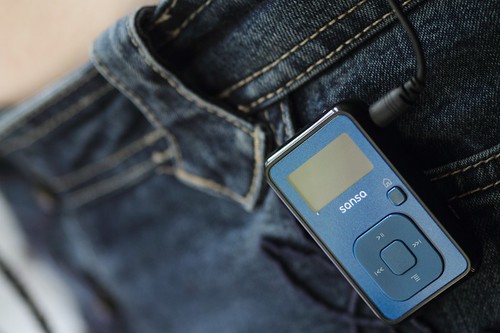
So get your geek on - buy a Sansa Clip+ and rock it up with Rockbox!
* To be fair, these are the low points, and her general music taste is stellar.
Deborah decided she wanted an MP3 player. She has a huge (and, at times, somewhat dubious) library of music on iTunes. Not being a fan of the apple, I don't know a great deal about this exotic piece of software, but I was aware that files are sometimes encoded as AAC files rather than good old fashioned MP3. So I kept this in mind when Deb asked me to look at players for her. A long time ago I read about the original Sansa Clip and had fancied one myself. Cheaper than an iPod Shuffle and with twice the storage capacity, I thought this would be the perfect player for everything from Guns n Roses to Evanescence (see what I mean?*).
I did think about AAC files, but I must have phrased the internet search incorrectly, as I ended up convinced it would work happily with iTunes. Indeed, it does. But if you want it to be able to actually play the files once they're uploaded, then you're out of luck. Yep...no AAC support.
I was, it is fair to say, rather annoyed with myself. On the plus side, I didn't sink into despair (helped by the amazingly cheap price of the player) and looked around for sollutions. It was then that I remembered Rockbox.
I don't know how I would have heard about it in the past, but Rockbox is a custom built OS for quite a range of MP3 players including, thank goodness, the Sansa Clip+. Along with a host of benefits (it even comes with tiny version of Pong preloaded!) it will play AAC files. I could have wept with joy.
The process wasn't quite as straight forward as I'd hoped. The automatic installation didn't work, and I ended up having to dive into the command prompt to install it manually. So a little time later we had a brand new, blue Sansa Clip+, which had been deified. becoming an awesomely cool god amongst MP3 players. It plays the AAC files perfectly, sound is superb, and thanks to the open source software, it is geekily wonderful in a way we both find ever so pleasing.
So get your geek on - buy a Sansa Clip+ and rock it up with Rockbox!
* To be fair, these are the low points, and her general music taste is stellar.
Friday, 17 June 2011
Podcast - Terry Pratchett: Choosing to Die review
Link to the MP3 for download
For the transcript, click here to visit Deborah's blog, Diary of a Goldfish
Subscribe to:
Posts (Atom)