Showing posts with label Theatre. Show all posts

Saturday, 4 August 2012

Olympic Interval - Bouncing Back (Including a review of As You Like It by Abbey Shakespeare)

This is written in part to honour the wonderful athletes who we've just been watching during the Women's Trampoline.  Great stuff.

As has happened to so many Olympians, my efforts, though driven and deliberate, floundered.  I'd hoped to post on my blog once a day for a week.  But really that was rather silly given what a week it's been.  On the plus side, I now get to write an additional post explaining my absense, and then I'll follow on with my planned subjects.

So, Wednesday.  Each year I take photos for the Abbey Shakespeare play at St Dogmaels Abbey.  I'd hoped in the morning to get on and write Thursday's post, but alas I just didn't have the time.  Instead, I was trying my best to look after Deborah who was very poorly.  I wasn't feeling too good myself - a muscle in my leg was spasming for 14 hours straight.

So in the end Deb had to stay back in the van (with her cold weather gear consisting of Russian-style hat, tights, leggings, fleece jacket and sleeping bag) and I went off to the play.  This year was As You Like It, a rather distinct change of mood from last year's King Lear.  And excitingly the play was the directorial debut of one of the long term cast.  He did a great job and I hope he's really proud of the result.

I tried a new tactic this year with photos - raising both the shutter speed and ISO.  I'm still getting used to how well the 7D deals with ISO noise so it took a great deal of trust.  Also new this year was my fantastic monopod.  I've used monopods in the past, but only the very cheapest ebay sells.  This year I treated myself to a Manfrotto 680B with a 494RC2 ball head and the beast was more solid than any tripod I've ever had, let alone a monopod.  I'd read some reviews which mentioned people using it as a walking stick at the same time as a camera support and that seemed entirely appropriate for my needs.  It might make taking photos around the garden a bit more straight forward.

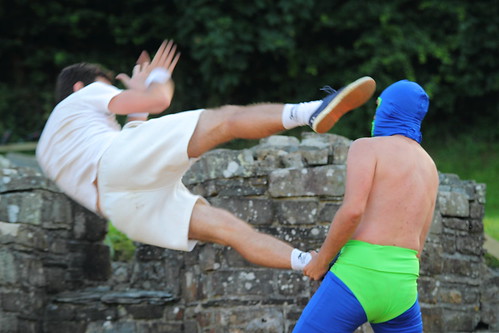
As for the play: it really was superb.  There was such a lot of humour packed in.  The rather eclectic modern setting was perfect and little touches (use of mobile phones and modern american wrestling) really raised it.  There were times it was hard to keep the camera steady from laughing.  The wrestling bout itself was very brave.

As You Like It - Abbey Shakespeare 2012
Photo of one man in one in mid air kicking another man in blue tights, lime pants and a blue hood in the face. And who wouldn't?  The colour clash deserves nothing less.

There were some great comedy performances from the supporting characters.

As You Like it - Abbey Shakespeare 2012 - My Favourites
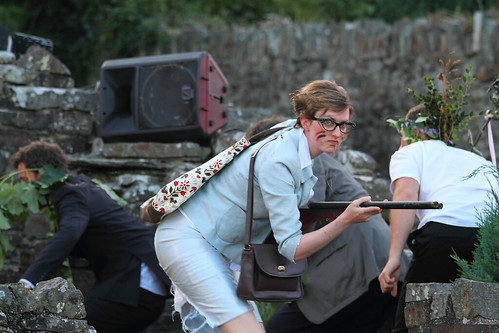
A woman in a light blue skirt suit with a replica shotgun, flowery bag and glasses pinched from the receptionist in Ghostbusters.

Not to mention the puppets.

As You Like It - Abbey Shakespeare 2012
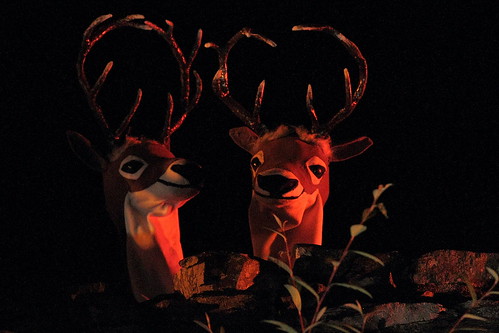
Two deer who are obviously deeply in love.

The leading actors were absolutely faultless.  And, of course, highly photogenic.

As You Like it - Abbey Shakespeare 2012 - My Favourites
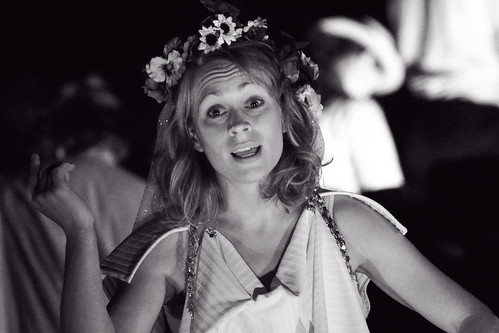
Rosalind played by Mary Glynn - a blonde woman with flowers in her hair being a great actor.

And who can object to a happy ending?

As You Like it - Abbey Shakespeare 2012 - My Favourites
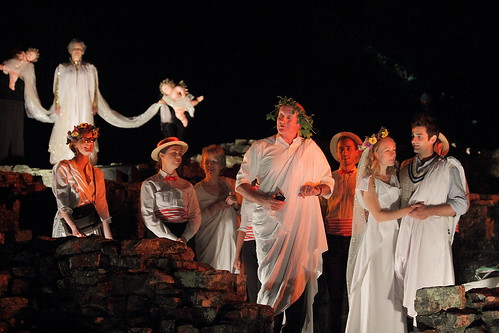
A happy ending - what more can you say?  Smiles, hugs and cherubs.  No, seriously, there are cherubs.

It took a day to edit the images and another day to get them all uploaded.  It has also taken a few days to get over the pain.  Hence the lack of blog posts.  But it was very much worth it.  I do hope that the rest of the run went well for the cast and crew.  The rain kept off for the entire evening on the Wednesday, but I'm not sure if that will have been the case for all the nights.  I also hope that they're pleased with the photos.  I would think as an actor, your memories of the performance might be strong but limited to your parts (not to mention your perspective).  Hopefully my perspective will make their memories stronger and more complete.

So now on with the next blog post...

Tuesday, 31 July 2012

2/5 - Equestrian (War Horse - Stage vs Screen)

Today's blog post honours the Equestrian stages of the Olympics.  My mother's been glued to the telly since yesterday morning...

Two years before my thirtieth birthday I had decided that I wanted to see a theatre production in London called War Horse.  There had been an article on the national news and a documentary.  I was very interested even without the publicity, but seeing the images of massive, life-sized horse puppets on stage really caught my imagination.

I'm not a horsey person.  The few times as a child I was taken on a donkey ride, I always felt for the poor beast carrying me.  But I do adore to see horses moving on their own.  They are something wild and free, if you like the cliche.  The ancient poetry I love equates horses with dangerous sexuality.  Of course, this makes perfect sense if you feel a wife needs to be broken in the same way you might a horse.  But I think it's more than that.  Horses are other.  They are alien in the same way that, say, a dolphin is.  But in an accessible way that almost allows you a glimpse of another kind of life.

So, although not horsey, I do have a great love for the equine form.  Puppetry, also, is something I admire.  I feel much the same about animation.  Creating a world with a set of tools which otherwise would be inanimate and cold.  It's magic, and so it makes sense that people would try to catagorise it as something for children.  Because the world can be cruel and stupid some times.

Finally, like many people my age going through the UK education system, I've been fed a steady diet of WWI since I was little.  The first assembly I remember in secondary school was taken by Mr Wilson, who banged a wooden blackboard rubber on a desk next to the microphone every second for a minute and then said 'That's a little like what it was like being in a bombardment.'  Good old Mr Wilson.

By the time I was fourteen I had a WWI poetry book complete with a photo of a dead (American I believe, but I can't remember the uniform off hand) soldier who, lying in the trench, had had any exposed flesh removed  by rats.  So a nice plump corpse with a completely skeletal head.  I read Birdsong (how I hate that book), the Regeneration trilogy (*so* much better) and as much poetry as I possibly could and the result was top marks in those sections in both GCSE and A-Level.

So while many people feel a great distance between their life and the Great Wars of history, I feel closer to them than I do, say, the Beatles.

So then, War Horse is a play about the plight of horses (and a particular horse and his boy) during the First World War.  Puppetry is used to bring both nature and the horror of human creation onto the stage.  The stage itself is circular and set up so that it can rotate.  Surrounding the stage are slashes of white like huge torn strips of paper.  The backgrounds (pencil drawings making them look like pages from a sketchbook) are projected onto these.  The main horse puppets (there are more than one) are handled by a team of puppeteers.  They wear black and, through some kind of psychological magic of the brain, they dissapear into the background.  No, that takes away from their work - it is their magic.  They mirror the movements of the horse, provide the horse's voice, they become the anima of the horse...its aura...its soul.

The film is a live action piece using real horses (and not such a little CGI) to tell roughly the same story.  However, there are some interesting alterations and additions to the narrative which were shocking to someone so wedded to the theatre production.  However, familiarity and love are not souly to blame for my distaste.  I believe they damage the story.

Firstly, and perhaps most importantly, the film has no blood or torn limbs.  There are no Saving Private Ryan flashes of gore.  The skeletal face forever associated in my soul with WWI never stares, eyeless, into the audience.  Of course, the theatre production never shows blood and gore either.  That'd be pretty difficult.  But using puppets they were able to provide us with horror by the bucket load.  So for example, there is a kindly captain who rides our horsey hero.  In the film his presumed death happens in cut away.  It's an interesting shot, but because we have no solid evidence for his demise, it feels somewhat lacking emotionally.  His death on stage, however, happens in slow motion agony, caught by a puppet shell.  Now the puppet shell I wasn't 100% convinced by.  But even so, it was better to see the men torn from their horses in the charge.  We felt their death.

One of the most upsetting things I have ever seen was the horses pulling artilery on the stage.  There was no way this could be done with real horses, or even CGI ones.  The horrific, ghost grey skeletal wrecks pulling the gun carriage and dying on stage were so important to the story.  You needed to see the real fate of these once fine beasts in order to understand the message of the narrative.

The eventual fate of both boy and horse are also both reduced and "enhanced".  So, if I've convinced you to watch the stage version, or you care about watching the film, you must stop reading now.

The mad flight of Joey the horse through the WWI battlefield is a CGI flop.  It loses a true sense of physics, and his eventual barbed-wire fate is far too over the top (to excuse the WWI pun).  The stage version is relatively slow and confined and so the wrapping of wire around the puppet and the noise...oh the noise.  The sheer truth.  And a boy blinded by gas...well, that's nothing to do with puppetry.  I was angry by how they handled that in the film.  It diminished the suffering of soldiers.  The reunion of horse and boy is a thing of blood, snot, tears and choking.  Anything less destroys the ending.

Speaking of which, the weird extension to the ending didn't make the film any better.  I felt they thought it needed that to show that everything would now be well.  Other examples of defference to an audience who might want easy answers - the elevation of the father from town drunk to 'gimpy' (oh the horror of that script) war veteran was very annoying.  It is an example of film narrative which cannot abide having less than positive people who aren't out and out villains.  On the stage, he does the wrong thing, people pay for that and they move on.  Such is life.

I think the horrors of war were pushed on the audience with the new (from the stage version - I should admit that I've not yet read the book) section involving the AWOL German children and their execution.  This felt like an invented section to allow us to feel hatred for the German soldiers.  Of course, we feel, the Brits would never do such a thing.  I mean, we even saw them stopping a child from signing up to war, when the Germans let any old (or not so old) child join up.  I really liked the inclusion in the stage play of the older German soldier who handles the horses.  His section really felt equal to the rest of the narrative.  It spoke of universals.  In the film, he's a bumbler who is very quickly dragged away, never to be seen again.

Also, what was up with the 'I'm so ill but with absolutely no physical sign of it and might die at any time' girl?  And the horse jumping over the tank??  Ugh, I should stop now.  But I probably won't.

So, there were problems with the narrative and with the use of live action horses.  What should they have done, presuming that they not just film the stage production (which I'd love to see, but which I'm also sure would lose a little something, with the audience not feeling the pounding of the horses on stage)?  I believe that animation would have given them options.  The story needs the use of abstract imagery in order to properly tell it.  You need to be able to see people thrown from horses and dying without necessarily seeing them splintered and bloody.  You need to be able to see horses mangled and dying.  You need to limit the sheer scope of the front so that you can take in even a fraction of the true horror.

Also, you need the humour which was almost completely removed (I say almost - I really liked the conversation about a hat).  Humour is life.  No matter how awful a situation, people still find things to laugh at.  Even if it's just my grammar.

And there's one more very important point.  I know that the soundtrack of the film was praised, but I felt that the work John Tams put into the stage soundtrack was immense.  The folk songs (and war songs) bought life to the people and the situation.

The stage production managed all the elements of the story and the truth about war in such a way that it was entirely accessible to everyone.  Humour, music, horror, beauty, truth and hope.  All the things that make up life perfectly balanced.  A child could see it, the Queen did see it, anyone can understand and empathise and grow.  The only ways I felt the film tried to make itself universal was to manage the blood and cursing.  That feels at best inauthentic and, at worst, manipulative entirely for the ultimate return of box-office gains.

I really will stop now.  The film's not necessarily a bad thing.  People spoke about the tears they shed feeling forced.  I didn't cry, but the times when I felt close were not because of the film, but because of the memories of the theatre production which, two years on, are still fresh and bright and living.  And I suspect they always will be.
Sunday, 20 November 2011

The Oxford Greek Play 2011 - Clytemnestra


On Thursday we braved the M25/40 trudge (complimented by beautiful sweeping views of late, low autumn honey-lit landscapes and at least ten squillion red kites) in order to get to the Oxford Playhouse.  What had we gone to see?  Well, the choice was either ‘Mother Goose’ (I’m not sitting through a production described as an ‘eggs-travaganza’) or ‘Clytemnestra’.  Thankfully, the booking staff were excellent (or should that be ‘egg-celent’?) over the phone and we were sorted with three seats for the Oxford Greek Play.

The Oxford Greek play is performed in...well, Greek.  I wish I could say that I had no need for the big, clear subtitle screens on each side of the stage, but alas, my degree was entirely in translation.  Even without language skills, I was really looking forward to hearing the tragedy in the original language.  There is something particularly musical about ancient Greek which suits the long, rhythmical speeches so beloved of Aeschylus.  And this ‘Clytemnestra’, despite the name, was an Aeschylus play – specifically the Choephoroi or Libation Bearers (the second play of the great tragic trilogy of the Oresteia).

So, a quick run-down of the plot – Agamemnon, high king of the Greeks, has been a busy bunny.  Not only has he killed his own daughter for a good breeze to get his ships to Troy, he’s also sacked the city (albeit after ten years siege), and has come home, slave girl in tow.  His wife, Clytemnestra, however, was not impressed by this behaviour and, with her new beau, set about planning his end.  In the first play of the trilogy, she tangled him up in a net of fabric while he was in the bath and set to him with a knife.

So far, so Essex.

And to make matters worse, there are more kids involved.  The surviving daughter, Electra, being a girl, hasn't got much sway, but she is not impressed with mummy’s murderous ways.  Orestes (the son whose name graces the trilogy) had been exiled for fear he might interfere, but by the time the Libation Bearers kicks off he’s back in town hungry for revenge.  The great god Apollo had told him he must do something about the crime (the killing of his father, not his father’s massacre of a nation, the sacrifice of his own daughter or any of that stuff.  Priorities, you know?) and by doing what he’s told, he’ll be safe from any sort of come back.

The play, then, is all about Orestes’ revenge, and this comes down to murdering Clytemnestra’s new fella, and, eventually, killing his own mother as well.  Obviously, with such a heavy job to do, there’s a lot to talk about.  And this is what Aeschylus does so well...

So, on to the play itself.  Firstly, I object to the title.  Call me fussy, but I love the chorus of mourning women (especially in this cast – not a weak member) and as they not only start off the theme of the play, but also take charge of the narrative and force the outcome (rare in ancient Greek drama) it is appropriate that they influence the title.  Clytemnestra is really pretty inconsequential – it’s all about a man’s worth, a man’s revenge, and a man’s eventual justice (albeit with the aid of a female goddess, but that’s another play entirely...)

My other major criticism was the lack of the line “Bring me my MAN KILLING AXE”.  There has not been such an amazing line in drama before or since, and anyone who fails to use it also fails to appreciate the full weight of the drama.  It is not just a fatal axe.  It’s a MAN KILLING AXE!

Aside from that, it was bliss.  The actress who played Electra entered the stage with a fractured beauty, her voice suiting the language so well I could have wept.  The stage design (a nod to both the Greek and Oriental) worked perfectly, and there were balletic touches (the weaving of a ribbon simulating the pouring of a libation, for example) which complimented and raised the heavy verse.

My pain-killers had worn off by the end of the first half and I was in a pretty bad way.  The fresh dose kicked in as the curtains rose for the second half.  It was a rather magical moment as the light caught on metal.  In one of the best pieces of set design I have ever seen, they had constructed full size Doric columns from multiple lengths of chain suspended between solid capital and base.  Sadly, the Star Trek style door of the main building did not work (although I’d now like someone to set Medea in a hotel ala The Shining), but aside from that, the rest of the stage craft, including costume, was great.

Oh, and not to go on about things that were wrong in my opinion, but there was this:  I could see something I shouldn’t, and couldn’t something I should.  No, it’s not the pills.  You see, the ‘silent character’ is important to all the plays of the trilogy.  Agamemnon has the ‘silent’ figure of Clytemnestra (sits there for ages before screaming and leaping around) and the Libation Bearers has Pylades.  But poor Pylades was only there in name, and as such his one line (which effectively amounts to ‘go on, kill your mum, you know you have to’) becomes an uncomfortable aside.  This was a mistake.  Instead, plagued by his mothers curse, we see the Furies assaulting him when Orestes clearly tells us ‘you lot can’t see this, but...’.  I understand why they’ve done this (you get to meet the Furies in the third play of the trilogy, and they don’t want you to miss out on the ‘pleasure’ when you’re there just to see play number 2), but it somewhat misses the point of what’s so scary about the scene anyway.  If, under the influence of my pain-killers, I’d got up and started screaming about the purple spiders eating my arm-pit hair, part of the fear the audience would felt would have come from not seeing something that had so upset me.

Even so, this still remains the best tragedy I have ever seen.  Even better than the Hippolytus where Theseus tripped over his cloak when carrying his dead wife.  Yeah, I know, I don’t have a great frame of reference, but trust me, this was something special and I enjoyed it very much.

Finally, if I’d been the cast, I’d have set about the audience with an axe (fatal...man-killing...it doesn’t matter which).  I’ve never known so many people to laugh inappropriately, and how it didn’t put off the actors I’ll never know.  It just makes me respect them all the more.